Featured

MBTI Personality Test

The MBTI Personality Test

Everything you do right now ripples outward and affects everyone. Your posture can shine your heart or transmit anxiety. Your breath can radiate love or muddy the room in depression. Your glance can awaken joy. Your words can inspire freedom. Your every act can open hearts and minds.

DAVID DEIDA

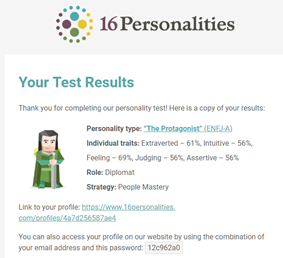
After Taking this MBTI Personality test, I was surprised to the result. I have Protagonist Personality which define as:

Protagonists are natural-born leaders, full of passion and charisma. Forming around two percent of the population, they are oftentimes our politicians, our coaches and our teachers, reaching out and inspiring others to achieve and to do good in the world. With a natural confidence that begets influence, Protagonists take a great deal of pride and joy in guiding others to work together to improve themselves and their community.

I don’t know if I possess this personality. But for sure, I dreaming to become a leader someday. When it comes to my work, I dedicate my work for the Glory of God.

Protagonist Strengths

  • Tolerant – Protagonists are true team players, and they recognize that that means listening to other peoples’ opinions, even when they contradict their own. They admit they don’t have all the answers, and are often receptive to dissent, so long as it remains constructive.
  • Reliable – The one thing that galls Protagonists the most is the idea of letting down a person or cause they believe in. If it’s possible, Protagonists can always be counted on to see it through.
  • Charismatic – Charm and popularity are qualities Protagonists have in spades. They instinctively know how to capture an audience, and pick up on mood and motivation in ways that allow them to communicate with reason, emotion, passion, restraint – whatever the situation calls for. Talented imitators, Protagonists are able to shift their tone and manner to reflect the needs of the audience, while still maintaining their own voice.
  • Altruistic – Uniting these qualities is Protagonists’ unyielding desire to do good in and for their communities, be it in their own home or the global stage. Warm and selfless, Protagonists genuinely believe that if they can just bring people together, they can do a world of good.
  • Natural Leaders – More than seeking authority themselves, Protagonists often end up in leadership roles at the request of others, cheered on by the many admirers of their strong personality and positive vision.

Protagonist Weaknesses

  • Overly Idealistic – People with the Protagonist personality type can be caught off guard as they find that, through circumstance or nature, or simple misunderstanding, people fight against them and defy the principles they’ve adopted, however well-intentioned they may be. They are more likely to feel pity for this opposition than anger, and can earn a reputation of naïveté.
  • Too Selfless – Protagonists can bury themselves in their hopeful promises, feeling others’ problems as their own and striving hard to meet their word. If they aren’t careful, they can spread themselves too thin, and be left unable to help anyone.
  • Too Sensitive – While receptive to criticism, seeing it as a tool for leading a better team, it’s easy for Protagonists to take it a little too much to heart. Their sensitivity to others means that Protagonists sometimes feel problems that aren’t their own and try to fix things they can’t fix, worrying if they are doing enough.
  • Fluctuating Self-Esteem – Protagonists define their self-esteem by whether they are able to live up to their ideals, and sometimes ask for criticism more out of insecurity than out of confidence, always wondering what they could do better. If they fail to meet a goal or to help someone they said they’d help, their self-confidence will undoubtedly plummet.
  • Struggle to Make Tough Decisions – If caught between a rock and a hard place, Protagonists can be stricken with paralysis, imagining all the consequences of their actions, especially if those consequences are humanitarian.

This strength and weaknesses will be my guide in all my decision in life. Above all, putting your faith to God is the greatest. To God be the Glory!

Plagiarism and PPST 7 Domain

Plagiarism

We learned that Plagiarism is the act of claiming someone else’s written work as your own unique creative expression, instead of giving credit to the original author. … Plagiarism means committing the crime of literary theft, or using another person’s words or ideas without crediting that person as the source.

Plagiarism is not good

Firstly, it is unethical because it is a form of theft. By taking the ideas and words of others and pretending they are your own, you are stealing someone else’s intellectual property. Secondly, it is unethical because the plagiarizer subsequently benefits from this theft.

Reasons why Students Plagiarize.

Some students will deliberately plagiarize when they feel themselves backed into a corner in a high-pressure situation with a low risk of being caught. Often, this behavior is a result of poor time management and organization skills.

PPST 7 Domain

The rapid changes and increased complexity of today’s education present new challenges on the part of the teaching profession. The improvement of technology, new trends in the teaching and learning process, social changes and dealing with the 21st century learners are some of the challenges that teachers facing today. The implementation of professional standards for teachers is one way of improving the teacher quality of the country.

In accordance with this, the Department of Education through the Teacher Education Council issued the DepEd Order No. 42, series 2017 or the National Adoption and Implementation of the Philippine Professional Standards for Teachers (PPST).The PPST targets to produce quality and better teachers in the country by improving the qualification of educators and increasing their level of knowledge, practice and professional engagement. This will also serve as the basis for all learning and development of teachers in order to ensure that teachers are properly equipped to effectively implement the K to 12 program. The new standards for teachers basically aims to: 1) set the clear expectations of teaches along well-defined career stages of professional development from beginning to distinguished practice; 2) engage teachers to actively embrace a continuing effort in attaining proficiency; and 3) apply uniform measure to assess teacher 8performance, identify needs, and provide support for professional development. The six modules of PPST are all anchored on the seven domains that quality teachers should exhibit: 1) Content knowledge and pedagogy; 2) Learning Environment; 3) Diversity of Learners; 4) Curriculum and Planning; 5) Assessment and Reporting; 6) Community Linkages and Professional Engagement; and 7) Personal growth and Professional Development.

The PPST will be a great help for the development and improvement of quality teachers in the country. And this will ensure better instruction in the teaching and learning process that will greatly contribute in producing knowledgeable, skilled, equipped and globally competitive learners.

Digital Issues and Information Management System

“Great things happen to those who don’t stop believing, trying, learning, and being grateful.” 

It was another fulfilling day with the knowledge learned that was introduced by the discussant.

Digital Issues:

I learned that digital issues like cyber bullying, Cybersex and Cybercrime are very rampant in todays’ computer media. Cyber Bullying are terms used to define recurrent and sustained verbal and/or physical attacks, by one or more children towards another child, who is unable or unwilling to deescalate the engagement using Information and Communication Technology (ICT). The cyberbully engages in harmful, repeated and harsh behavior intended to deprecate a targeted child. Cyberbullying describes threatening or disparaging communications delivered through ICT.

Cyber Sex is a virtual sex encounter in which two or more persons connected remotely via a computer network send one another sexually explicit messages describing a sexual experience. It is a form of role playing in which the participants pretend they are having actual sexual intercourse, by describing their actions and responding to their chat partners in mostly written form designed to stimulate their own sexual feelings and fantasies.

Cybercrime is defined as a crime in which a computer is the object of the or is used as a tool to commit an offense. Cybercriminals may use computer technology to access personal information, business trade secrets or use the internet for exploitative or malicious purposes. Criminals can also use computers for communication and document or data storage. Criminals who perform these illegal activities are often referred to as hackers. And, cybercrime may also be referred to as computer crime.

Information Management System

            Information Management System (IMS) is a general term for software designed to facilitate the storage, organization and retrieval of information. IMS is also the name of IBM’s mammoth software program developed in the 1960s to support NASA’s Apollo space program.

            What is the purpose of an information management system? A Management Information System, or MIS, collects data from many different sources and then processes and organizes that data to help businesses make decisions. These days, technology and data collection are so prevalent that businesses large and small are using Management Information Systems to improve their outcomes.

            What are the advantages of management information system? A management information system provides the data to identify non-performing areas and leads to the following benefits: Helps to achieve a higher level of efficiency: Managers have the information needed to identify a company’s strengths and weaknesses.

7 C’s of 21st Century and Digital Divide

This day (May 5, 2019), new lesson was presented to us by the discussants. They presented the meaning and emphasize the importance of each lesson.

7 C’s of 21st Century

The first lesson was 7 C’s that underlies the 21st century lifelong learning skills. These 7Cs are derived from a number of contemporary efforts to define the essential skills needed for a society’s future workforce.

Critical Thinking-This is all about creating open challenges for students that require research and analysis of information along with problem-solving and analytic thinking

Creativity-Being innovative will continue to be a key driver, and, yes, you can teach creativity. By giving opportunities and environments that allow students to be curious seekers of new knowledge, we lead them to exercise their creative muscles. For the future, they will need to design creative solutions, tell artful stories, and curate a collection of designs in their new world.

Communication-The quality of your ideas is meaningless if ‘you no talk no good’ because communicating your purposes to others is an essential part of determining the success or failure of an endeavor. This includes the ability to craft and analyze the information you give and receive. In a modern context, it also pertains to media literacy.

Collaboration-Even if you develop an incredible initial concept, you will need a team of people to help bring it to life. Do you play well with others? Even if you are in a leadership role (or perhaps especially) you need to be able to connect, cooperate, compromise, and build community. That’s 4 more Cs just in this 1 area.

Cross-Cultural Understanding-Since the creation of the internet, the world has become a much more connected place and the future will require your students to be able to interact in that space. This is about global citizenship that spans across diverse ethnic groups, cultures, and ideas. The UN Sustainable Development Goals will play a large role in guiding you here.

Computing Technology-While the technology is certain to change, a basic understanding of troubleshooting and logical program creation and design will always be important. It’s even more crucial that students learn how to navigate in a world of electronic information and how they can become positive digital citizens.

Career Learning-This area encompasses many of the job and life skills that have always been crucial. That means everything from setting and achieving goals, managing time, being organized and effective, and dealing positively with workplace challenges. It also entails self-reliance and self-care. One of the most important parts of career learning and life is cultivating the concept that you are a lifelong learner.

Digital Divide

Digital divide is a term that refers to the gap between demographics and regions that have access to modern information and communications technology, and those that don’t or have restricted access. This technology can include the telephone, television, personal computers and the Internet.

The major cause of the digital divide is access. Although this is the majorcontributing factor, there are other factors that contribute which include the following:cost of technology, access for the disabled, lack of skills, lack of education, lack of information, and lower-performance computers.

THE IMPORTANCE OF BRIDGING THE DIGITAL DIVIDE. Access to computers and the Internet and the ability to effectively use this technology are becoming increasingly important for full participation in America s economic, political and social life.

ICT and MIL

Information and communications technology (ICT) is an extensional term for information technology (IT) that stresses the role of unified communications and the integration of telecommunications (telephone lines and wireless signals) and computers, as well as necessary enterprise softwaremiddleware, storage, and audiovisual systems, that enable users to access, store, transmit, and manipulate information.

ICT is a broad subject and the concepts are evolving. It covers any product that will store, retrieve, manipulate, transmit, or receive information electronically in a digital form (e.g., personal computers, digital television, email, or robots). For clarity, Zuppo provided an ICT hierarchy where all levels of the hierarchy “contain some degree of commonality in that they are related to technologies that facilitate the transfer of information and various types of electronically mediated communications”. Theoretical differences between interpersonal-communication technologies and mass-communication technologies have been identified by the philosopher Piyush Mathur. Skills Framework for the Information Age is one of many models for describing and managing competencies for ICT professionals for the 21st century.

What is the importance of information and communication technology?

It can improve the quality of human life because it can be used as a learning and education media, the mass communication media in promoting and campaigning practical and important issues, such as the health and social area. It provides wider knowledge and can help in gaining and accessing information.

Media and information literacy (MIL) is linked to access to information, free expression and education. … Media and Information Literacy (MIL), defined as the ability to access, analyze, and create media, is a prerequisite for citizens to realize their rights to freedom of information and expression

Why is media and information literacy is very important?

Because being media literate means being able to access, analyze, and evaluateinformation, which we receive through media. Being media literate means being able to create media messages and to use the technology tools available to us.

What is the purpose of information literacy?

Evaluate information and its sources critically. Incorporate selected informationinto one’s knowledge base. Use information effectively to accomplish a specificpurpose. Understand the economic, legal, and social issues surrounding the use ofinformation, and access and use information ethically and legally.

Generations

My report is all about the generations of people.

generation is “all of the people born and living at about the same time, regarded collectively“. It can also be described as, “the average period, generally considered to be about thirty years, during which children are born and grow up, become adults, and begin to have children of their own”.[1] In kinship terminology, it is a structural term designating the parent-child relationship. It is also known as biogenesisreproduction, or procreation in the biological sciences.

“Generation” is also often used synonymously with cohort in social science; under this formulation it means “people within a delineated population who experience the same significant events within a given period of time”.[2] Generations in this sense of birth cohort, also known as “social generations”, are widely used in popular culture, and have been the basis for sociological analysis. Serious analysis of generations began in the nineteenth century, emerging from an increasing awareness of the possibility of permanent social change and the idea of youthful rebellion against the established social order. Some analysts believe that a generation is one of the fundamental social categories in a society, while others view its importance as being overshadowed by other factors including class, gender, race, and education, among others.

Currently, five generations make up our society. Each of those five generations has an active role in the marketplace. Depending on the specific workplace, the workforce includes four to five generations. Here are the birth years for each generation:

  • Gen Z, iGen, or Centennials: Born 1996 – TBD
  • Millennials or Gen Y: Born 1977 – 1995
  • Generation X: Born 1965 – 1976
  • Baby Boomers: Born 1946 – 1964
  • Traditionalists or Silent Generation: Born 1945 and before